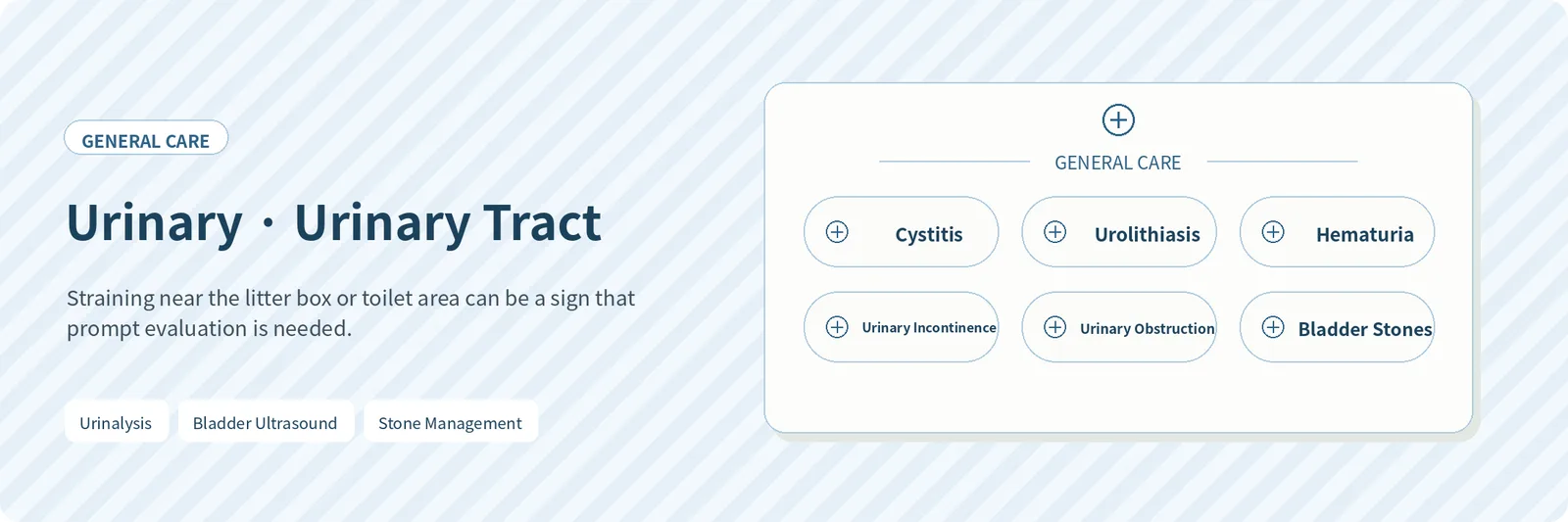
Urinary Tract
If your pet hesitates before urinating, today is the day to check.
Signs to watch for
- Frequent attempts to urinate with little output
- Blood in urine or darker urine color
- More accidents outside the litter box
- Pain or crouching while urinating
- A male cat unable to urinate at all (EMERGENCY!)
* Urethral obstruction in male cats can become life-threatening within a day or two — it is an emergency.
What causes it?
Cystitis
Inflammation of the bladder lining. In cats, stress alone can trigger it (feline idiopathic cystitis), so environmental care matters too.
Urinary stones
Minerals in urine clump into stones — building up slowly like limescale in a kettle. Depending on the type, they can be dissolved with diet or removed surgically.
Urethral obstruction
Stones or debris block the urethra so urine cannot pass — like a completely clogged drain. Immediate treatment is essential.
How we diagnose & treat
- 1
Step 1. History & palpation
We review urination frequency, posture, and urine color, and palpate the bladder.
- 2
Step 2. Urinalysis
Blood, crystals, bacteria, and urine specific gravity.
- 3
Step 3. Imaging
X-ray and ultrasound to locate stones and assess the bladder wall.
- 4
Step 4. Treatment
Medication, prescription diet, catheterization, or surgery — staged by cause.
- 5
Step 5. Prevention
More water intake, litter box environment, and keeping up the prescription diet to prevent recurrence.
Key conditions
- Bacterial cystitis
- Feline idiopathic cystitis (FIC)
- Bladder & urethral stones
- Urethral obstruction
- Hematuria
- Chronic recurrent urinary tract infection
FAQ
Especially for male cats, this is an emergency. Please call us now and come in. The longer it lasts, the greater the risk of kidney damage.
Contact Us
Ask us about these symptoms
10:00 AM – 9:00 PM · Closed Tuesdays (Open weekends)