Scaling & Polishing
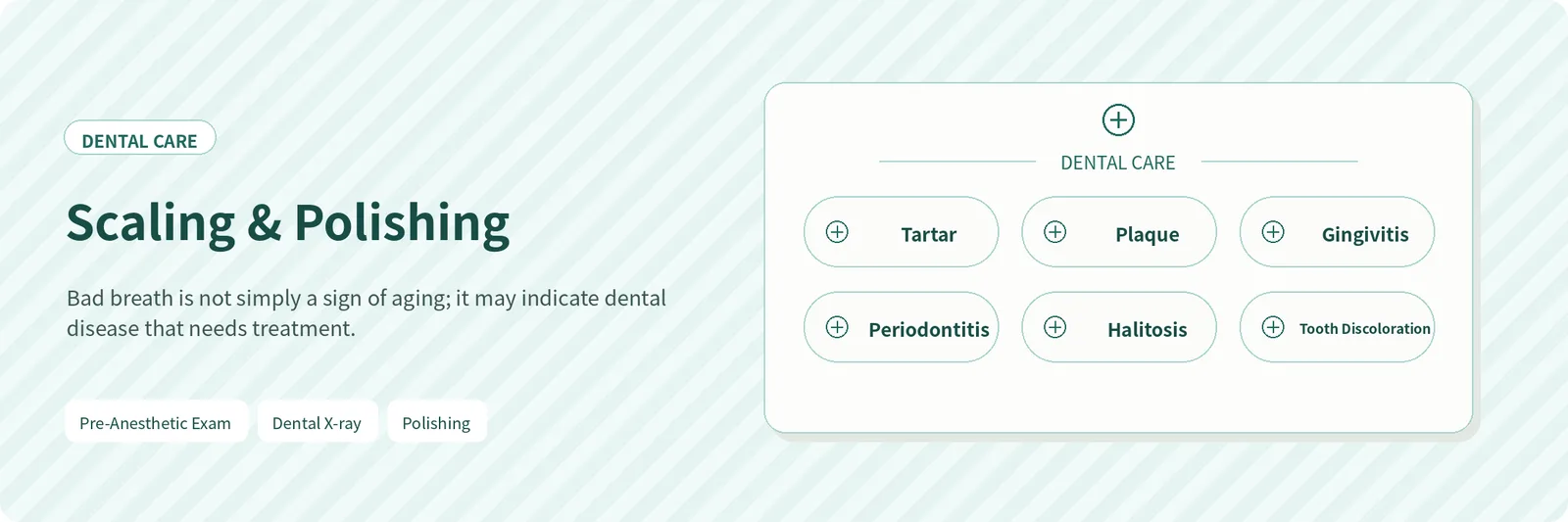
Bad breath is not just a sign of aging — it is a sign that treatment is needed.
Signs to watch for
- Bad breath has gotten worse
- Yellow tartar is visible on the teeth
- Red gums and resistance to tooth brushing
- Avoids hard food or chews on one side only
- Drooling or rubbing the face often
What causes it?
Tartar and periodontitis
Plaque hardens into tartar in about 3 days. Tartar digs below the gumline and loosens the tooth's foundation — like soil washing away beneath a pillar.
Why scaling requires anesthesia
The critical tartar is invisible below the gumline. Anesthesia-free scaling only polishes the visible surface and can actually mask disease — under carefully monitored anesthesia we clean below the gumline as well.
The role of polishing
Polishing smooths the tooth surface after scaling. A rough surface lets tartar reattach faster, so scaling and polishing are one set.
How we diagnose & treat
- 1
Step 1. Oral exam & consultation
We assess tartar and gum condition and discuss the anesthesia plan.
- 2
Step 2. Pre-anesthetic testing
Blood tests and cardiac evaluation to confirm anesthetic fitness.
- 3
Step 3. Scaling & polishing
Tartar above and below the gumline is removed under anesthesia, and the surface polished.
- 4
Step 4. Dental X-ray (if needed)
Root condition below the gums is imaged to decide whether extraction is needed.
- 5
Step 5. Recovery & home care coaching
After recovery we guide tooth brushing habits and checkup intervals.
What's included
- Ultrasonic scaling
- Polishing
- Subgingival curettage
- Dental X-ray
- Extraction when needed
- Home care coaching
FAQ
All anesthesia carries some risk, but pre-anesthetic testing and monitoring during the procedure lower it substantially. For senior pets or those with underlying conditions, we decide together whether to proceed after additional testing.
Contact Us
Ask us about these symptoms
10:00 AM – 9:00 PM · Closed Tuesdays (Open weekends)