Oral Disease
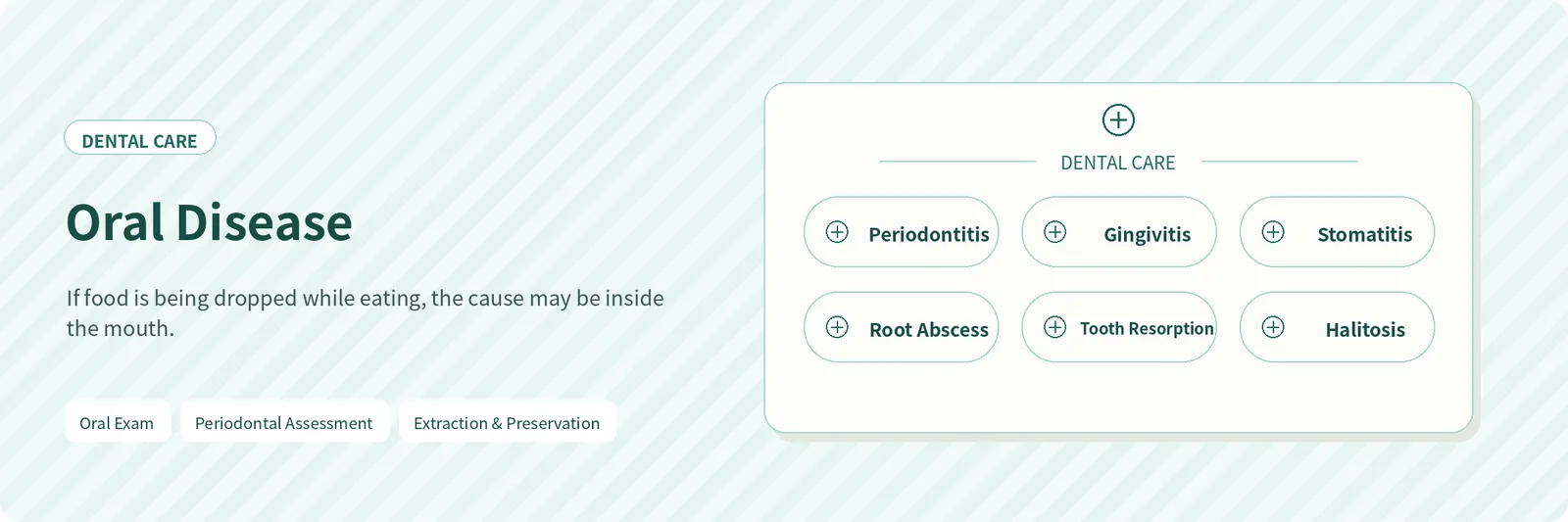
The reason your pet leaves food behind may be inside the mouth.
Signs to watch for
- Stops mid-meal or drops food
- Avoids having the mouth touched
- Blood mixed in saliva
- Very red gums or visible ulcers
- Swelling on one side of the face
* Severe gum inflammation in cats may be stomatitis, which is very painful and directly affects quality of life.
What causes it?
Periodontitis
Inflammation that starts with tartar spreads to the gums and the bone around the teeth. Left alone, teeth loosen and the burden extends to the jawbone, the heart, and overall systemic health.
Feline stomatitis
Severe inflammation and pain throughout the mouth, thought to be an excessive immune response. In some cases full-mouth extraction can become an option to relieve pain.
Tooth resorption (cats)
A uniquely feline disease in which teeth dissolve from within. Lesions that look small on the surface cause severe pain, so dental X-rays are used to confirm.
How we diagnose & treat
- 1
Step 1. Oral exam
Gum and tooth condition and pain response.
- 2
Step 2. Dental X-ray
Roots and jawbone are imaged to find lesions invisible on the surface.
- 3
Step 3. Treatment planning
Conservative care versus extraction is decided together, from a pain and quality-of-life perspective.
- 4
Step 4. Dental procedure
Scaling, extractions, and stomatitis treatment under anesthesia.
- 5
Step 5. Pain & relapse management
Diet, home care, and checkup schedule after recovery.
Key conditions
- Periodontitis
- Feline stomatitis
- Tooth resorption
- Full-mouth extraction (cats)
- Retained deciduous teeth
- Tooth root abscess
FAQ
Once the source of pain is removed, appetite often improves. Pets eat well with wet or softened food after extraction, and we guide the recovery diet.
Contact Us
Ask us about these symptoms
10:00 AM – 9:00 PM · Closed Tuesdays (Open weekends)